
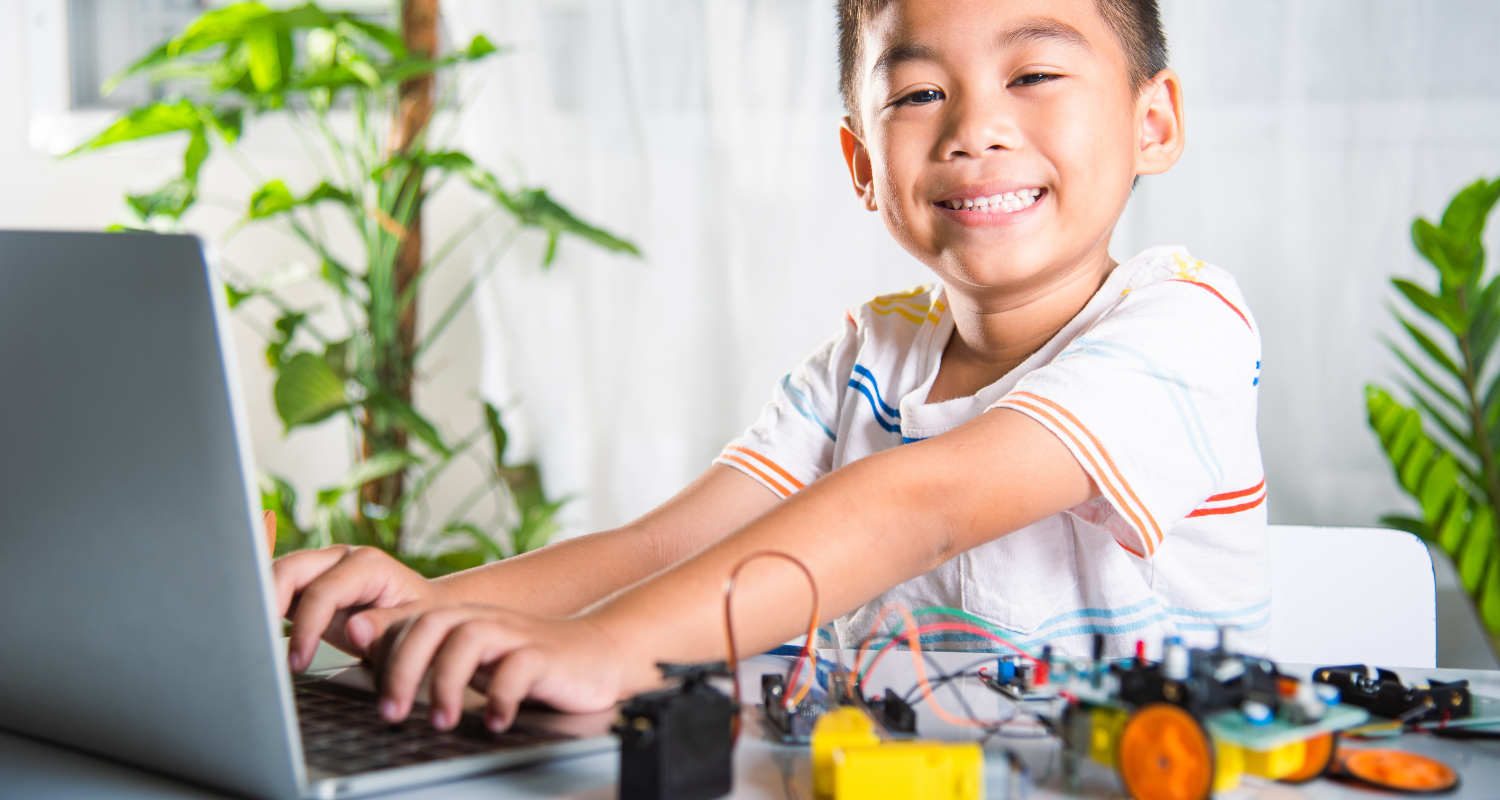
Learning programming at a young age does much more than teach children how to write code, it fundamentally strengthens the way their brains think. In today’s digital world, coding is not just a technical skill; it is a powerful tool for developing logical reasoning, creativity, and resilience.
When children engage with programming, they learn how to approach problems in a structured and thoughtful way. These skills go far beyond computers and impact how they learn, think, and solve challenges in everyday life.
Programming, or coding, is the process of giving instructions to a computer to perform specific tasks. For children, this often starts with simple visual tools like block-based coding before moving into more advanced languages.
But more importantly, programming teaches children how to think, not just what to type.
It introduces them to key concepts such as:
Logical reasoning
Step-by-step thinking
Pattern recognition
Problem decomposition
These foundational skills are essential not only in technology but also in subjects like mathematics, science, and even decision-making in daily life.
One of the biggest benefits of learning programming early is the development of computational thinking.
Computational thinking is a problem-solving method that includes:
Breaking down complex problems into smaller parts (decomposition)
Identifying patterns
Creating step-by-step solutions
Testing and improving results
For example, when a child builds a simple game, they must think logically:
What happens when a player clicks a button?
What rules should the game follow?
What happens if something goes wrong?
This structured thinking strengthens the brain’s ability to analyze and solve problems effectively.
Research in cognitive development strongly supports the benefits of coding for children.
Studies have shown that activities involving structured logic and sequencing improve executive function skills, including:
Working memory
Flexible thinking
Self-control
These are critical skills for academic success and lifelong learning.
A study in educational technology found that students who participated in coding activities showed measurable improvements in mathematical reasoning compared to those who did not.
This happens because programming strengthens neural pathways related to:
Logical reasoning
Abstract thinking
Analytical processing
During childhood, the brain is highly adaptable, a property known as neuroplasticity. This means learning programming early can have a lasting impact on how the brain develops and processes information.
Programming naturally teaches children how to approach problems in a structured way.
Instead of feeling overwhelmed by a big challenge, children learn to:
Break it into smaller, manageable parts
Solve each step individually
Combine solutions into a complete result
This process builds confidence and helps children become more independent thinkers.
Over time, they begin to apply this mindset not only in coding but also in:
Schoolwork
Decision-making
Real-life challenges
One of the most powerful lessons programming teaches is resilience.
In coding, mistakes are normal. Programs rarely work perfectly on the first try. Children quickly learn that:
Errors are part of the process
Debugging is a skill
Trying again leads to improvement
This trial-and-error experience builds persistence and patience.
Psychologists refer to this as a growth mindset, the belief that abilities can improve through effort and learning.
Children who develop this mindset are more likely to:
Stay motivated
Overcome challenges
Achieve long-term success
Coding transforms frustration into curiosity and encourages kids to keep exploring solutions.
Many people think coding is purely technical, but it is also highly creative.
Through programming, children can create:
Games
Animations
Websites
Mobile apps
They bring their ideas to life using technology.
Research in STEM education shows that combining creativity with logical thinking leads to:
Deeper understanding
Better memory retention
Higher engagement in learning
When children build their own digital projects, they move from consuming content to creating meaningful experiences.
As technology continues to shape the global economy, digital skills are becoming increasingly important.
According to global workforce reports, some of the fastest-growing skills include:
Programming
Data analysis
Artificial Intelligence
Digital problem-solving
However, the true value of learning programming early is not just about future careers; it is about developing the brain.
Here’s a quick summary of how coding helps children grow:
Improves logical and analytical thinking
Strengthens problem-solving skills
Encourages creativity and innovation
Builds resilience and persistence
Enhances mathematical understanding
Prepares children for future opportunities
Programming is more than a technical skill, it is a way of thinking.
By learning coding early, children develop stronger cognitive abilities, better focus, and a mindset that embraces challenges and creativity.
The goal is not just to teach kids how to code, but to help them:
Think clearly
Solve problems effectively
Create confidently
In a rapidly changing world, these are the skills that truly matter.